Showing posts with label Heat Transfer. Show all posts

Cooling Coil


One of the main functions of refrigeration systems is to decrease temperature of air flow. One thing that always occurs naturally along with decrease in temperature is the moisture reduction. In the air conditioning, for comfort or industrial, decrease of moisture is usually considered as desirable goal. In this case is emphasized on cooling and reduction of air humidity at temperatures range 5 to 35 oC.

Most of cooling coil is usually consists of pipe with fins attached to the outside, it is intended to expand surface area in contact with air. Generally, its convection coefficient is lower than water. Water flows inside pipe and air flows outside finned pipes.

Some terms and notions of cooling coil construction that as often used as follow:
-          Face area of the cooling coil: the cross-sectional area of air flow at the entrance of cooling coil.
-          Face velocity of the water: the volume of air flow rate is divided by surface area coil.
-          Surface area of the coil): the heat transfer surface area in contact with air.
-          Number of rows of tubes: i.e. number of rows (tubes, pipes) that are in the direction of air flow.
READ MORE - Cooling Coil

LMTD Heat Exchanger (Logarithmic Mean Temperature Difference)


The main factor to calculate and design heat exchanger is heat transfer problem. If amount of heat which is released is equal to Q with regulations of time, then cold fluid will receive heat as Q with equation:

Q = U . A . ΔTm

Where:
Q = released / received heat
U = overall heat transfer coefficient
A = area of ​​heat transfer
ΔTm  = Difference in average temperature
 
Before determining surface area of ​​heat (A), then the value of LMTD Heat Exchanger (Logarithmic Mean Temperature Difference) should be first determined. This is based on the difference in inlet temperature of fluid and outlet temperature of heat.

For different parallel flow direction of fluid, in which:

ΔTmax = ( T1 – t1 ) : ΔTmin = ( T2 – t2 )

For opposite luid flow, then:

ΔTmax = ( T1 – t2 ) : ΔTmin = ( T2 – t1 )

Where:
LMTD = Logarithmic Mean Temperature Difference
T1 = temperature of fluid into shell
T2 = temperature of fluid out of shell
t1 = temperature of fluid into tube
t2 = temperature fluid out of tube

In design heat exchanger, actual difference in average temperature should be calculated by using correction factor (Ft). Amount of actual difference in average temperature (ΔTm) is:

ΔTm = Ft × LMTD

READ MORE - LMTD Heat Exchanger (Logarithmic Mean Temperature Difference)

Fouling Factor in Heat Exchanger


Fouling Factor in Heat Exchanger greatly influence heat transfer process. This fouling can occur because sediment from flowing fluid. Fouling factor can be also caused by corrosion on components of heat exchanger due to the influence of the fluid type that flows through it.

During the heat exchanger is operated, fouling factor will inevitably occur. The occurrence of this fouling can disturb or affect temperature of fluid flow and can also reduce or affect the overall heat transfer coefficient of fluid.

Several fouling factors in heat exchanger as follow:
-          fluid temperature
-          wall tube temperature
-          velocity of fluid flow

Fouling factor in heat exchanger can be calculated by following equation:

where:
Uc = overall coefficient net of heat transfer
hio = coefficient of heat transfer on outside surface of tube
ho = coefficient of heat transfer fluid on outside tube
Ud = overall coefficient (design) of heat transfer 
READ MORE - Fouling Factor in Heat Exchanger

Conduction Heat Transfer

Conduction heat transfer is the heat transfer through medium without accompanied by displacement of the particle medium. Conduction usually can occur in solids such as various types of metal and glass. For example, if one end of metal is heated, the other end of metal will also feel hot because heat transfer process from one end to other end.

The existence of temperature gradient will make heat transfer process occur. Heat transfer in solids arises due to movement between atoms at high temperature, so that the atoms can move heat. In liquids or gases, the hot is distributed by the collisions between molecules.

Basic equation of conduction heat transfer:

Description:
q = rate of heat transfer
k = thermal conductivity
A = sectional area of ​​dT

The basic relation through conduction heat flow is comparison between rate of heat flow across isothermal surface and gradient contained on the surface which valid at every point in an object at any point in an object on any time which is known as Fourier law as follow:

Description:
A = isothermal surface area
n = distance, measured normal (perpendicular) to the surface
q = rate of heat flow across the surface in normal direction
T = temperature
K = thermal conductivity

Proportionality constant (k) is the physical properties of material that is called thermal conductivity. The unit used in thermal conductivity is Cal/cm Sk. To convert this unit to Btu/ft hour ºR is multiplied by 242.9 and to transform into W/cm K or J/cm Sk is multiplied by 4.1866. Based on the formula, it can be carried out measurements in an experiment to determine the thermal conductivity of various materials. Generally, thermal conductivity is highly dependent on temperature.
READ MORE - Conduction Heat Transfer

Heat Transfer in HRSG


Heat transfer is the transfer of energy that occurs due to temperature differences between objects or materials. In thermodynamics, the moving energy is heat. Analysis on heat transfer rate should be considered. Generally, heat transfer in HRSG that occurs there are three kinds:
  1. Conduction heat transfer
  2. Convection heat transfer
  3. Radiation heat transfer

In this case, the heat transfer which is used is conduction heat transfer, convection and combination of conduction and convection. In the HRSG boiler is assumed does not use additional fuel and heat sources only from exhaust gases of gas turbine. So it does not analyze the radiation heat transfer in this HRSG boiler.

  1. Conduction Heat Transfer
Conduction heat transfer is the transfer of heat from one part of solid objects to other parts of same solid object without any movement of solid molecules itself. Generally, equation used in the conduction heat transfer is:

  1. Convection Heat Transfer
Convection heat transfer is the heat transfer which is performed by molecules of fluid (liquid or gas). Generally, the equation of convection heat transfer is:

where Tw is temperature of solid object while T∞ is temperature of fluid.

Convection heat transfer consists of two types of heat transfer. I.e., free convection heat transfer in which the air velocity is assumed does not exist. As for air that has flow is type of forced convection where the effect occurred at Nuselt number for every condition is different.

2.a. Free Convection Heat Transfer
Free convection heat transfer in HRSG as follow:

-          On horizontal cylinder:

Multiplication between the Grashof number and Prandtl numbers is called Rayleigh number:

Ra = Gr . Pr

Where the Rayleigh number can be calculated as follow:

where:
Tw = temperature of surface
T∞ = ambient air temperature
υ = kinetic viscosity
g = gravity (9.8 m/s2)
δ = D = characteristic dimension
β = coefficient of volume expansion

-          On the ball

The equation above can be changed by entering Prandalt number, thus can be obtained following formula:

Then the value of free convection can be obtained as follow:


-          Through inner cylinder

-          Through bank of tubes

where:
C = flow coefficient across bank of tubes
Re = Reynolds Number
Pr = Prandlt Number
do = outside diameter of cylinder / tubes
di = inside diameter of cylinder

  1. Combination of Conduction and Convection Heat Transfer
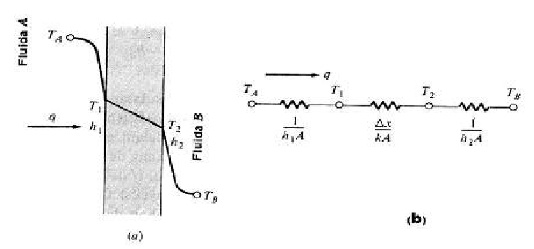
Heat transfer that occurs in HRSG is a combination of conduction and convection, such as the following figure where on one side there is hot fluid A and on the other side fluid B has cooler temperature.
Figure 1: Heat Transfer on Flat Plane
(Source: Heat Transfer Book - Holman JP)

Heat transfer can be expressed as:

Heat transfer can be described in the network above, so that the overall heat transfer is calculated by dividing overall temperature difference by the amount of thermal resistance:

Overall heat flow as a result of the combined conduction and convection can be expressed by thorough heat transfer coefficient (U), formulated in relationship:

where A is the area of ​​heat flow field, in accordance with the above equation then the overall heat transfer coefficient is:

READ MORE - Heat Transfer in HRSG